REVIEW · TOKYO
Asakusa Night Evening Walking Tour with English-Speaking Guide
Book on Viator →Operated by GuideMe Japan · Bookable on Viator
Lantern light makes Asakusa feel brand-new. This short Asakusa night walking tour strings together the best early-evening sights, before dinner turns the streets into chaos. You’ll move from the iconic Kaminarimon Gate area to calmer temple grounds and then finish in a lane built for izakaya hopping.
I love the way the guide turns what you see into something you understand. I also like that the pace is efficient: it’s only about one hour, so you get context without blowing your entire evening.
One possible drawback: the big ticket temple space has timing limits. The main hall at Sensō-ji closes at 6 PM, so if you arrive later, parts of the experience may be more about views and streets than interior time.
In This Review
- Key things that make this Asakusa night walk work
- Why Asakusa looks different after dark
- The meeting point: start near Kaminarimon, not at some far hotel
- Kaminarimon Gate at night: the photo spot plus the context
- Sensō-ji Temple after the crowds: calm, respectful, and story-driven
- Asakusa Shrine right beside it: a quieter spiritual side
- Hanayashiki Street: where fun and tradition sit next to each other
- Hoppy Street at the end: dinner gets easier
- Guides make the difference: what Takumi and Mio bring
- Price and value: $34.29 for an hour that sets your evening up
- Who should book this Asakusa night walking tour
- Quick practical notes so you don’t waste time
- Should you book it?
- FAQ
- How long is the Asakusa night walking tour?
- What is included in the price?
- Are food and drinks included?
- Where does the tour start and end?
- Is a ticket provided on your phone?
- How big is the group?
- Is Sensō-ji admission affected by closing times?
Key things that make this Asakusa night walk work
- Small group size (up to 8) keeps the walk calm and questions easy.
- English-speaking guide adds stories you usually miss when you go solo.
- Built for before dinner: you end in an eating zone instead of wandering off hungry.
- Night lighting changes everything around Kaminarimon and nearby shrines.
- Two-day sightseeing friendly: it helps if you already visited during the day.
- No food included, so you’re free to choose what fits your budget and tastes.
Why Asakusa looks different after dark
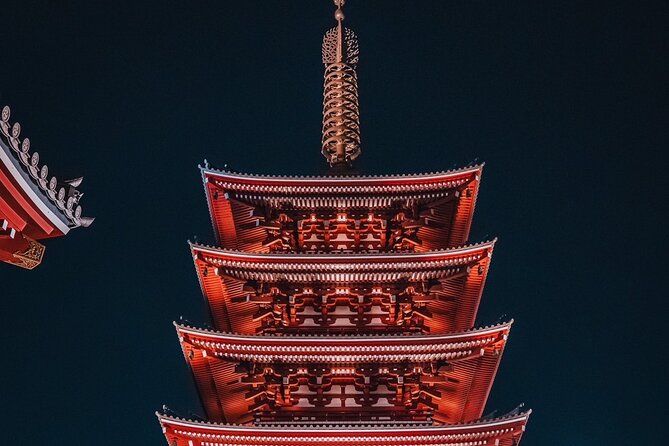
Asakusa is famous in daylight for crowds and photos. At night, the same places feel more human-scale. Lantern glow softens the big sights, and the back streets start to feel like places people actually use.
This tour is built around that timing sweet spot. You get the main landmarks while the light is still photogenic, and you’re done in time to make dinner decisions with your feet already in the right neighborhood.
Also, the route is short on purpose. With only about an hour on the clock, you’re not stuck rushing between stops all night. It’s a focused hit of the area.
You can also read our reviews of more walking tours in Tokyo
The meeting point: start near Kaminarimon, not at some far hotel
You start near Kaminarimon at a very specific landmark: Burger King Asakusa Azumabashi in Taito City. That helps, because you’re not trying to decode a meeting spot tucked into a side street.
The tour is also set up for easy public-transport access, which matters in Tokyo. If you’re coming from another part of the city, you can treat this as a low-stress pre-dinner activity instead of a logistical project.
You’ll also use a mobile ticket, so plan on having your phone charged. It’s a small thing, but it saves you from last-minute stress when you’re standing under lanterns looking for your group.
Kaminarimon Gate at night: the photo spot plus the context
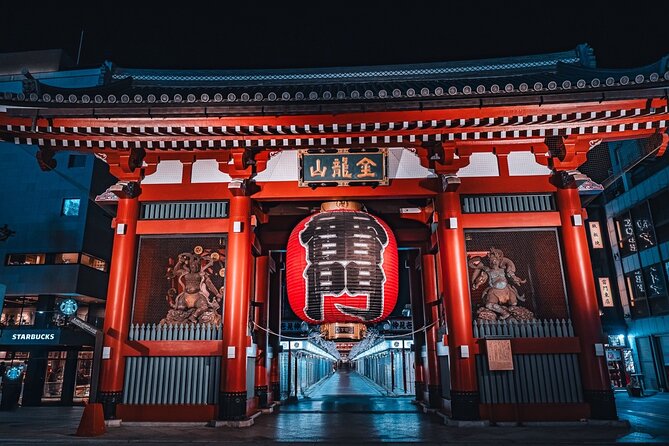
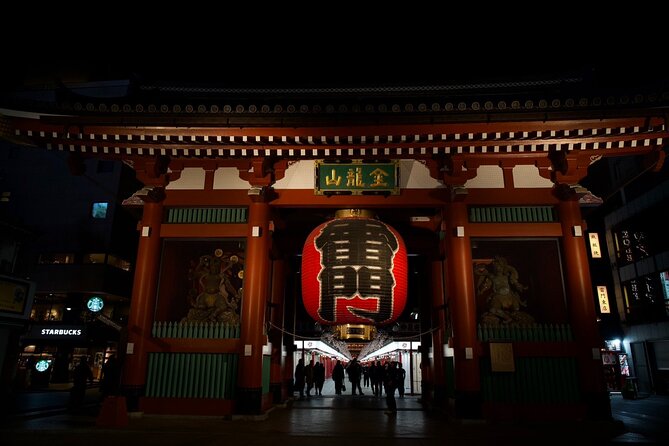
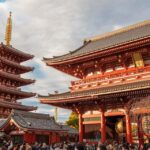
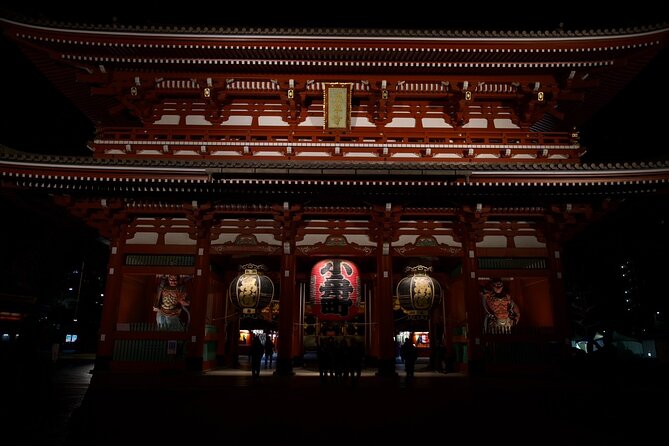
The walk opens at Kaminarimon Gate, the Thunder Gate entrance to Sensō-ji. Even if you’ve seen it in photos, at night it’s more dimensional. The red lantern is still the star, but the edges feel less crowded and more sculpted by shadows.
Here’s why this stop matters: the gate isn’t only an Instagram moment. You’ll hear what the Thunder Gate represents, including the idea of the gate’s guardians—Fujin (god of wind) and Raijin (god of thunder). That kind of detail makes the whole area click when you move on.
Then you get to the shopping lane right next door, Nakamise Street, which leads toward the temple. In daylight it’s a snack-and-souvenir funnel. At night, it becomes more of a browse-and-snack rhythm, with smaller pockets of activity.
Tip for you: if you want a quick taste, this is where the options are close and the atmosphere is still lively. If you skip snacks here, you won’t feel behind later—your itinerary keeps things balanced.
Sensō-ji Temple after the crowds: calm, respectful, and story-driven
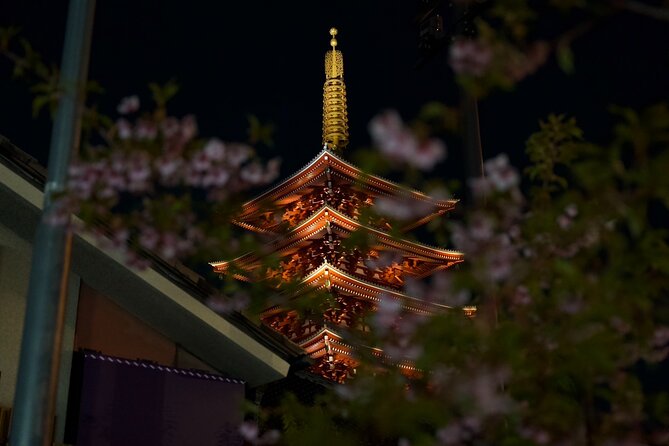
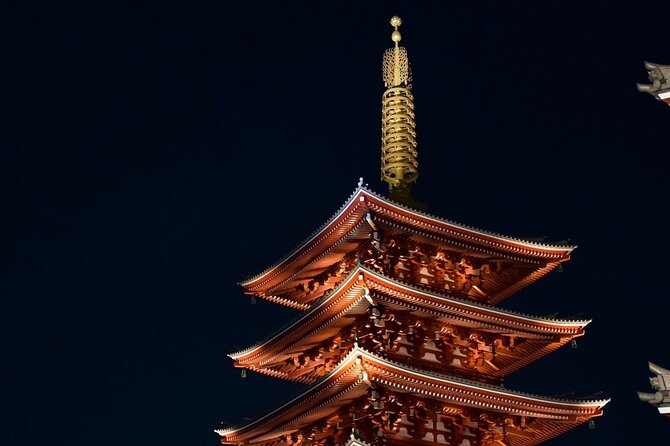
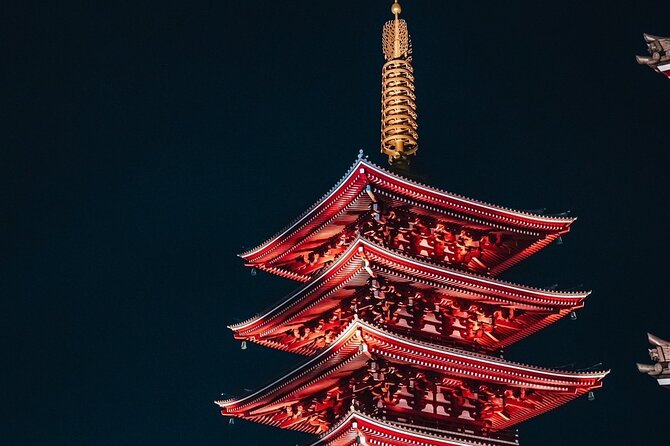
Next you spend time at Sensō-ji, one of Tokyo’s best-known temples. At night, it’s easier to slow down and notice details that daylight crowds steamroll.
The key practical point: the main hall closes at 6 PM. That means your ability to go inside depends on your start time. Even if you can’t enter the main hall, you’ll still experience the temple grounds and the feeling of the complex after the peak rush.
What I find most valuable here is how the guide links the space to meaning. Sensō-ji is dedicated to Kannon, the goddess of mercy, and hearing that framing changes how you read the statues, the incense area, and the flow of the grounds.
If you’re visiting after 6 PM: don’t treat this as a disappointment. The value is the atmosphere and the explanations around what you’re seeing.
Asakusa Shrine right beside it: a quieter spiritual side
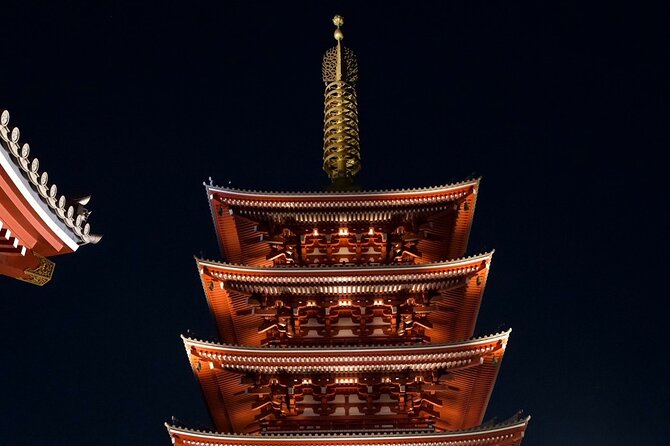
After Sensō-ji, the tour moves to Asakusa Shrine, located next to the temple complex. It’s a Shinto shrine dedicated to the three men who founded Sensō-ji, and it survived World War II, which adds a layer of real-world weight to what can otherwise feel like a decorative stop.
This is the kind of stop that rewards someone who likes meaning, not just sights. The shrine gives you a second religious lens in a small walking radius, which makes Asakusa feel less like one attraction and more like a lived-in neighborhood of traditions.
You’ll have time to look around without feeling yanked along. That matters for temples and shrines, where you often want a minute to stand, watch, and absorb.
You can also read our reviews of more guided tours in Tokyo
Hanayashiki Street: where fun and tradition sit next to each other
The route continues to Hanayashiki Street, an area named after Hanayashiki, Japan’s oldest amusement park. Even if you don’t plan on riding anything, the street gives Asakusa its everyday edge.
This stop is a good reset. After temples and shrines, you get the rhythm of shops, cafés, and casual street life. It also helps you avoid the feeling that the whole evening is only ceremonial spaces.
Practical thought: because it’s near major sights, you may still see visitors. But at this point in the tour, you’re not just fighting crowds. You’re browsing in a more relaxed mode.
Hoppy Street at the end: dinner gets easier
The tour finishes at Hoppy Street, a famous alley lined with izakayas. This is where the neighborhood turns into a food game plan. The street is known for serving hoppy, a popular local drink, and the shops offer a range of Japanese pub-style food and drinks.
Ending here is smart for you. Instead of standing at the end of a tour thinking, Okay, where do we eat?, you’re already at a concentrated zone full of choices. You can also match your dinner to your mood—something quick, something cozy, or something lively.
If you’re not sure what to order, you’ll have options in front of you. And since the tour doesn’t include food, you’re not stuck with a fixed menu you might not like.
One small consideration: izakayas can be busy, especially later. If you want a shorter wait, consider heading in soon after the tour ends.
Guides make the difference: what Takumi and Mio bring
The whole experience rises or falls on the guide. This tour’s reviews highlight that the best part isn’t just seeing temples—it’s understanding what you’re looking at.
I like the pattern: guides explain the story behind the landmarks, so Kaminarimon and Sensō-ji stop being generic photos. In particular, guides such as Takumi and Mio have been praised for making the evening walk informative and enjoyable, with energy that helps the walk feel light instead of lecture-heavy.
It’s also helpful if you did Asakusa during the day already. One of the biggest upsides of this night approach is that it gives you the missing context—so your daytime visit suddenly makes more sense, like you’ve connected the dots.
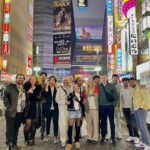
Because the group is small (up to 8 people), questions don’t feel like a burden. If you want to ask about legends, etiquette, or what a sign or statue might mean, you’re not shouting over a crowd.
Price and value: $34.29 for an hour that sets your evening up
At $34.29 per person, this isn’t a bargain price. But it’s also not trying to be a half-day production. You’re paying for an English-speaking guide, a tight route, and the convenience of starting near Kaminarimon and ending in a dinner alley.
Here’s how I judge value for a tour like this:
- If you’re going solo, you might spend time searching for what’s important. This gives you focus.
- If you already saw Asakusa in daylight, you get a second pass with context instead of repeats.
- If you’re hungry after temple-hopping, you finish near Hoppy Street, which reduces the stress of where to eat.
If you’re the type who likes your travel with story and pacing, the price makes sense. If you prefer total freedom with no guide, you might not need this. But for one hour, it’s a solid way to start an evening in Tokyo without wasting it.
Who should book this Asakusa night walking tour
This tour is a strong fit if you:
- Want an easy pre-dinner activity that doesn’t hijack your night
- Like history and legends but don’t want to read a guidebook for hours
- Prefer a small group atmosphere
- Have already seen Asakusa in daylight and want the context you missed
- Appreciate temple and shrine visits that include meaning, not just photos
It also works well for first-timers in Tokyo. You get a concentrated introduction to a neighborhood that feels distinct from the city’s neon zones.
Quick practical notes so you don’t waste time
The tour lasts about 1 hour. Plan for that, then build dinner immediately after at Hoppy Street.
Wear shoes you can walk in. You’ll be moving from gate to street to temple grounds to shrine and back into shopping and alleyways.
Bring cash if you want the option to snack or drink, even though food and drinks aren’t included. Tokyo is flexible, but having a little backup never hurts.
And because the Sensō-ji main hall closes at 6 PM, consider the time you book. If you’re aiming for interior time, you’ll want to be there earlier in the evening.
Should you book it?
I’d book this if you want Asakusa without the guesswork. The small group size, the English-speaking guidance, and the way the tour ends on Hoppy Street make it feel built for real evenings, not just checkboxes.
I’d skip it if you want a long, self-guided wander. The route is short, so it won’t replace hours of exploring on your own. Also, if you arrive after 6 PM, don’t expect the Sensō-ji main hall experience to be identical to daytime visits.
Still, for a one-hour night starter that adds meaning and sets up dinner, this tour is a good use of time in Tokyo.
FAQ
How long is the Asakusa night walking tour?
It’s about 1 hour.
What is included in the price?
An English-speaking guide is included.
Are food and drinks included?
No. Food and drinks are not included.
Where does the tour start and end?
It starts at Burger King Asakusa Azumabashi and ends on Hoppy Street.
Is a ticket provided on your phone?
Yes, it uses a mobile ticket.
How big is the group?
The maximum group size is 8 travelers.
Is Sensō-ji admission affected by closing times?
The main hall at Sensō-ji closes at 6 PM, so entry may not be available after that time.