REVIEW · TOKYO
Tokyo: Asakusa – Walking Tour
Book on GetYourGuide →Operated by Japandas · Bookable on GetYourGuide
Temple steps and shopping in one 3-hour loop. In Asakusa, I love the moment you cross Kaminarimon with its red lantern, and I like how the tour takes you from there to Sensō-ji so you’re not just wandering blind through gates and crowds.
Do plan for one small logistics snag: one booking report said their Uber dropped them far from where they needed to be, and they had trouble finding the guide afterward. If you show up late or get dropped off away from Sumida Park, watch for the guide with the blue panda flag so you can start cleanly.
In This Review
- Key highlights worth your time
- Sumida Park start: get oriented before you go temple-hopping
- Crossing Kaminarimon and Nakamise-dori without getting lost in the fun
- Sensō-ji via the Hozomon Gate: a guided way to see the main hall
- Asakusa Shrine: understand the Buddhism–Shinto fusion you’re seeing
- Asakusa Sumo Club: tradition you can spot, not just read about
- Don Quijote at the end: the easiest place to turn sightseeing into souvenirs
- Price and ticket value for $21 per person
- Who this Tokyo Asakusa tour is best for
- Practical stuff: shoes, weather, and staying on track
- Should you book this Asakusa walking tour?
- FAQ
- How long is the Tokyo: Asakusa – Walking Tour?
- How much does the tour cost?
- Where is the meeting point, and how do I recognize the guide?
- What language is the live tour guide?
- What places does the tour include?
- Is admission to ticketed sites included?
- What should I bring, and what’s not allowed?
Key highlights worth your time
- Sumida Park start with river-and-Skytree views: You begin with a better sense of where you are before the temples.
- Kaminarimon Gate + Nakamise-dori walk: Classic Asakusa postcard scenery paired with practical on-the-ground route guidance.
- Sensō-ji Main Hall through the Hozomon Gate: You hit one of Tokyo’s biggest sacred sites in a logical order.
- Asakusa Shrine and the Buddhism–Shinto link: You get a clear explanation of why these traditions overlap here.
- Asakusa Sumo Club as a living tradition stop: It’s not just a photo op, it’s a culture check-in.
- Don Quijote for souvenirs and snacks: You finish with a shopping/curiosity option that’s easy to use.
Sumida Park start: get oriented before you go temple-hopping
This tour begins at Sumida Park, with the Sumida River and Tokyo Skytree in the background. That first stretch matters. Tokyo can feel like one long blur of streets, and this start gives you a mental anchor before you step into the older Asakusa lanes.
From that river view, you move toward the iconic gate areas and the thick mix of worshippers, shoppers, and street activity that defines Asakusa. You’ll also be walking, so the earlier part is a good warm-up: you’re not immediately dropped into the busiest temple entry crush without easing in first.
One practical note: the meeting point is tied to a real, specific place. The guide will be carrying a blue flag with a panda on it. Use that as your “human landmark,” especially if you’re arriving via taxi or ride-share and the drop-off isn’t perfectly aligned with your expectations.
You can also read our reviews of more walking tours in Tokyo

Crossing Kaminarimon and Nakamise-dori without getting lost in the fun
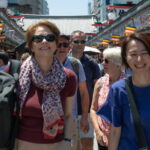
Once you reach Kaminarimon Gate, you’re stepping into one of the most recognizable entry scenes in Tokyo. The red lantern is the headline here, and the guide helps you move past it like you know what you’re doing, not like you’re just following a crowd.
After that, you’ll walk Nakamise-dori, the famous street lined with long-running shops and stalls. This part is where Asakusa feels like a neighborhood, not a staged attraction. You’ll see traditional sweets and the kind of merchandise that makes souvenir shopping feel fun instead of forced.
Here’s how this segment helps you as a visitor: it trains your eyes. After Nakamise-dori, when you approach gates and temple spaces, you’ll already understand the rhythm of Asakusa—street first, then ceremonial entry points. That makes the next stops land better.
If you want the most out of Nakamise-dori, wear shoes that can handle slow walking. This is also the point where you may pause for snacks or browse, and you don’t want sore feet steering your choices.
Sensō-ji via the Hozomon Gate: a guided way to see the main hall
The route continues to the Hozomon Gate, the entrance to the Main Hall of Sensō-ji Temple. Sensō-ji is described as the oldest and most visited Buddhist shrine in Tokyo, and the scale of it is part of the experience. It can feel overwhelming if you arrive with no plan.
What I like about this approach is the order. You don’t just drift into the main hall area; you’re routed through the gate that leads into it. That small structure gives you a clearer picture of what you’re looking at and why the spaces feel layered.
The guide also frames what’s happening around you. In a temple space, it’s easy to focus only on what looks photogenic. With guidance, you’re more likely to notice the purpose of the entry, the flow of people, and the way people treat the space with respect.
Drawback to keep in mind: temple areas tend to be crowded, and this is one of the biggest stops. If you prefer quiet sightseeing, plan to take it slow once you reach the main hall area and let the group pace set your rhythm.
Asakusa Shrine: understand the Buddhism–Shinto fusion you’re seeing
Next up is Asakusa Shrine, dedicated to the founders of Sensō-ji. It’s a key stop for understanding why Asakusa doesn’t fit neatly into one box.
The tour explains the fusion between Buddhism and Shintoism, which is important context. Even if you don’t read every sign, you’ll notice how shrine and temple areas can feel connected—different elements, different traditions, but shared cultural space.
This stop is also a nice change of pace after Sensō-ji’s biggest hall focus. It helps you step back and see the broader relationship between the two sites, instead of treating them as separate checklist items.
If you like cultural meaning, this is one of the most worthwhile parts of the tour. If you mainly want Instagram-level sights, it still works, but the value here is in the interpretation and understanding.
Asakusa Sumo Club: tradition you can spot, not just read about
One of the more distinctive inclusions is the Asakusa Sumo Club. Instead of making sumo feel like a distant sport history lesson, this stop is about seeing tradition continue in real life.
The tour positions it as a place that keeps Japanese sumo tradition alive. That means it’s not only about seeing buildings and gates. You get at least one break from the temple-heavy rhythm and you return to something more everyday, more human-scale.
How to think about this stop: it’s a change of scenery and a cultural palate cleanser. Even if you already know sumo basics, it’s a chance to connect the sport to place and practice, which is where cultural tours often earn their keep.

Don Quijote at the end: the easiest place to turn sightseeing into souvenirs
After temple and culture stops, you finish by passing Don Quijote, described as the most popular shopping and curiosity store. This is practical. It gives you an option for souvenirs, snacks, and those slightly oddball items Tokyo is good at.
I like this kind of ending because it solves a common travel problem: you don’t always want to spend your last hours hunting down a store when your feet are tired. If you want to buy something, you’ll have a straightforward place to do it.
Also, Don Quijote can be a comfort stop if you’re traveling with people who want different things. One person wants last-minute gifts. Another wants a quick snack. You’re not stuck negotiating which shop to enter, because you already have a big, easy target.
Price and ticket value for $21 per person
At $21 for a 3-hour walk, the big value question is what’s included beyond narration. The tour includes admission to sites that require a ticket purchase, including temples, museums, and other venues that require a ticket. Imperial Gardens is listed as an example of a ticketed venue type.
That inclusion matters because temples and museums can add up quickly once you start paying one-off entry fees. Instead of gambling on whether you’ll spend more money than you expected, you’re buying a set of planned visits where ticket costs are handled as part of the package.
Two more value notes:
- You’re paying for guided order and context, which improves how the stops connect in your mind.
- Transportation is optional. The info says transportation to/from the meeting point or between attractions is optional private transportation at an additional cost. So don’t assume rides are included; this is primarily a walk.
If you’re trying to keep costs controlled while still seeing the big Asakusa highlights, $21 feels fair—especially since the tour spans major cultural sites plus a shopping stop.
Who this Tokyo Asakusa tour is best for
This walking format fits best if you:
- Want a structured route through Asakusa’s main sights.
- Like the idea of learning what you’re seeing, not just photographing it.
- Prefer a guided mix of temple culture and practical shopping.
It’s also wheelchair accessible, which is great if you need a more supportive pace and route planning. Still, it’s a walking tour, so comfort and route suitability can vary depending on your mobility needs and how busy the streets are.
Language matters too. The live guide is Spanish. If you speak little Spanish, you can still follow along, especially around what to look for, but you may miss some of the spoken context.
Practical stuff: shoes, weather, and staying on track
Bring comfortable shoes and comfortable clothes. This is one of those Tokyo tours where the length is short but the walking adds up, and you’ll be better off in supportive footwear.
Weather is also straightforward: the activity happens regardless of conditions. So check what’s coming and bring umbrella, rain gear, or a raincoat. In rain, the comfort advantage of good shoes becomes even bigger.
And there are clear rules: no smoking, no drones, and no alcohol or drugs. If you plan to carry drinks, keep it within normal sightseeing behavior, but follow what the tour explicitly restricts.
Finally, the meeting point details are not theoretical. The guide is carrying a blue panda flag, and the coordinates point you to the Sumida Park area. If you’re using ride-share, try to be early and watch closely when you arrive.
One caution from a booking experience: if you get dropped off far from the right spot, it can be hard to recover quickly. So I recommend building in a buffer time and locating your guide visually before the group begins moving.
Should you book this Asakusa walking tour?
I’d book this tour if you want an efficient 3-hour route that hits the core Asakusa highlights: Kaminarimon, Nakamise-dori, Sensō-ji, Asakusa Shrine, the Asakusa Sumo Club, and an easy ending at Don Quijote. The inclusion of admission to ticketed sites adds real value for the price, and the guided order makes the temple stops easier to understand.
I’d think twice if logistics stress you out. With a small review sample and at least one report about difficulty finding the guide after an incorrect ride-share drop-off, you’ll want to be proactive about meeting point timing and spotting the blue panda flag. Go early, verify you’re at Sumida Park, and start clean.
If you’re comfortable with walking and you like guided context (in Spanish), this is a solid way to experience traditional Tokyo culture without building a complicated day plan.
FAQ
How long is the Tokyo: Asakusa – Walking Tour?
It lasts 3 hours.
How much does the tour cost?
The price is $21 per person.
Where is the meeting point, and how do I recognize the guide?
The guide will be carrying a blue flag with a panda on it. The provided coordinates are 35.7107915, 139.7979734.
What language is the live tour guide?
The live tour guide speaks Spanish.
What places does the tour include?
You’ll cross Kaminarimon Gate, walk Nakamise-dori, visit Sensō-ji Temple and Asakusa Shrine, pass by the Asakusa Sumo Club, and shop at Don Quijote.
Is admission to ticketed sites included?
Yes. The tour includes admission to sites that require a ticket purchase, such as temples or venues like Imperial Gardens.
What should I bring, and what’s not allowed?
Bring comfortable shoes and comfortable clothes, and pack for weather since the tour runs regardless of conditions. Smoking, drones, alcohol, and drugs are not allowed.